Major Changes to Primary 1 Registration From 2027
Parents preparing for Singapore’s 2027 Primary 1 registration exercise have an important new set of rules to understand.
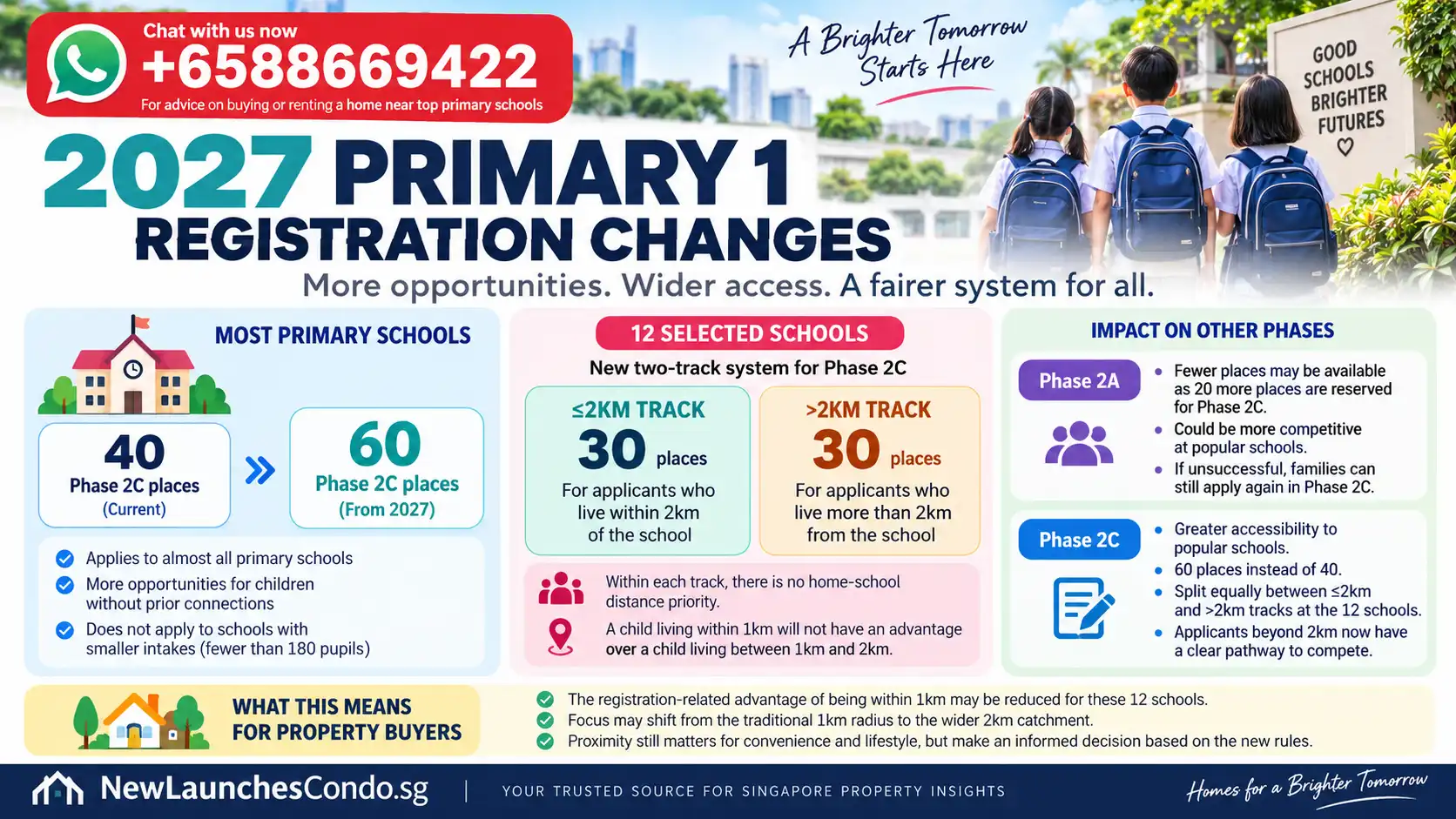
From 2027, most primary schools will reserve 60 places for Phase 2C, up from the current 40, giving more children without prior connections to a school an opportunity to apply.
An even bigger change will affect 12 primary schools, including several highly sought-after schools in Bukit Timah, Newton and the East Coast.
What Parents Need to Know — In 30 Seconds
- Most primary schools will reserve 60 Phase 2C places, instead of 40.
- The change applies from the 2027 P1 registration exercise.
- 12 selected schools will introduce a special two-track Phase 2C system.
- 30 Phase 2C places at these schools will be reserved for children living within 2km.
- Another 30 places will be available to children living more than 2km away.
- Within each track, there will be no further home-school distance priority.
Why Is MOE Increasing Phase 2C Places?
Phase 2C is especially important because it is open to children who have not already secured a Primary 1 place and who may not have the connections required for the earlier registration phases.
At most schools, the minimum number of places reserved for Phase 2C will therefore increase from 40 to 60 places.
The change will not apply to schools with smaller Primary 1 intakes of fewer than 180 pupils.
What Does This Mean for Phase 2A and Phase 2C?
One of the less obvious effects of the announcement is that the additional Phase 2C places have to come from somewhere.
By reserving another 20 places for Phase 2C, there may be fewer places available in the earlier registration phases at some schools. This could make competition during Phase 2A more significant, particularly at popular schools with strong demand.
- More places being reserved for Phase 2C means fewer places may remain available to the earlier registration phases.
- This could make Phase 2A more competitive at certain popular schools.
- Phase 2A does not have a fixed allocation of 40 places. Its actual vacancies depend on the school’s intake, Phase 1 registrations and the places reserved for subsequent phases.
- Families unsuccessful in Phase 2A still have another opportunity to apply during Phase 2C, provided their child has not already secured a place elsewhere.
- Phase 2C becomes more accessible, with 60 reserved places instead of 40 at most primary schools.
- At the 12 selected schools, 30 places will be reserved for applicants living within 2km and another 30 for applicants living beyond 2km.
- Within the ≤2km track, living within 1km provides no additional priority over living between 1km and 2km.
- Applicants living beyond 2km now have a dedicated track through which they can compete for Phase 2C places at these schools.
The Biggest Change: A New Two-Track System for 12 Schools
The most significant announcement involves 12 schools located in neighbourhoods where public housing makes up less than 40% of homes within a 2km radius.
For these schools, the 60 reserved Phase 2C places will be divided equally:
Reserved for applicants who live within 2km of the school.
Reserved for applicants who live more than 2km from the school.
Which 12 Primary Schools Are Affected?
The new two-track Phase 2C system will initially apply to:
- Anglo-Chinese School (Junior)
- Anglo-Chinese School (Primary)
- CHIJ (Katong) Primary
- Methodist Girls’ School (Primary)
- Nanyang Primary School
- Ngee Ann Primary School
- Pei Hwa Presbyterian Primary School
- Raffles Girls’ Primary School
- Singapore Chinese Girls’ Primary School
- St. Margaret’s School (Primary)
- Tanjong Katong Primary School
- Tao Nan School
So Is Living Within 1km of a Popular Primary School Still Important?
This is probably the question many parents — and property buyers — will immediately ask.
The answer requires an important distinction.
For the 12 schools under the new two-track system, the traditional advantage of being within 1km will change substantially for Phase 2C.
A family living 500 metres from Nanyang Primary School, for example, will not receive additional Phase 2C priority over another family living 1.5km away.
Both households fall into the same ≤2km Phase 2C track.
This is important because parents have traditionally placed considerable emphasis on purchasing or renting a property within the coveted 1km school radius.
What Could This Mean for Property Buyers?
For many years, homes within 1km of highly sought-after primary schools have attracted considerable interest from parents planning ahead for Primary 1 registration.
For Phase 2C at these 12 schools, moving from a property 1.5km away to one 500 metres away will no longer improve a family’s home-distance priority. Both addresses fall into the same ≤2km track.
This could potentially reduce some of the registration-related advantage traditionally associated specifically with owning or renting a property within 1km of these schools.
At the same time, it does not mean that living close to a school becomes irrelevant.
Families within 2km still have 30 Phase 2C places specifically reserved for their track. A nearby home can also offer practical benefits such as a shorter daily school journey and greater convenience for families.
For property buyers, the new system may therefore shift some attention from the traditional 1km radius towards the wider 2km catchment surrounding these 12 schools.
🏡 The Property Takeaway
The 2027 changes appear to reduce the Phase 2C advantage of buying or renting extremely close to certain popular primary schools.
For the 12 affected schools, a home within 1km and a home between 1km and 2km will now be treated equally for distance purposes within the ≤2km Phase 2C track.
At the same time, families who live farther than 2km away gain a much clearer opportunity: 30 Phase 2C places are specifically reserved for the >2km track.
For families who are already eligible for Phase 2A, it will also be worth watching competition closely, as the larger Phase 2C reservation may leave fewer vacancies available in earlier phases at some popular schools.
What About Primary Schools Not in the List of 12?
This is another very important distinction.
The special ≤2km and >2km two-track system applies only to the 12 selected schools.
At other primary schools, the prevailing home-school distance priorities continue to apply when balloting is required.
Therefore, parents should not assume that the importance of the 1km school radius has disappeared across Singapore.
What Should Parents Do Now?
The biggest lesson from the announcement is that families should avoid making a property decision based simply on old assumptions about Primary 1 registration.
If you are considering buying or renting a home because of a particular primary school, first establish:
- Which P1 registration phase your child is likely to qualify for
- Whether the school is one of the 12 schools under the new two-track arrangement
- Whether the property falls within 1km, between 1km and 2km, or beyond 2km
- The school’s historical registration demand and balloting record
- Your family’s own housing, enrolment and schooling timeline
More Primary 1 Registration Guides
We have been closely following Singapore’s changing Primary 1 registration landscape. These earlier guides provide additional background:
2026 Primary 1 Registration: Shrinking Vacancies & The Impact on Property Prices → 2026 Primary School Vacancies: What Parents and Property Buyers Should Know →The Bottom Line
The 2027 changes represent a significant adjustment to Singapore’s Primary 1 registration framework.
Increasing the number of reserved Phase 2C places from 40 to 60 should create more opportunities for children without existing school connections.
The new arrangement at the 12 selected schools goes further. Half of the Phase 2C places will remain available to families living within 2km, while the other half will be opened specifically to applicants living farther away.
For Phase 2C applicants at these schools, being within 2km will determine which track they enter — but being within 1km rather than 1–2km will no longer provide additional distance priority within the local track.
For property buyers and tenants, that is an important change to understand before paying a premium purely to secure an address within 1km of one of these schools.
Looking for a Home Near a Top Primary School?
Whether you are planning to buy or rent a property within 1km of a popular primary school, or would like to compare homes within the wider 2km radius, we can help you shortlist suitable properties.
💬 Find Properties Near Top Primary Schools
Important:
Primary 1 admission is never guaranteed by purchasing or renting
a property near a school. Registration remains subject to the
prevailing Ministry of Education rules, citizenship priority,
registration phase eligibility, vacancies, home-school distance
rules and balloting requirements.
Property-to-school distance should always be independently verified
using the applicable official tools before making a property decision.
Source: Ministry of Education announcement reported on
10 September 2026.