If you are keen on a monthly informational newsletter on the latest New Launches projects in Singapore, do sign up for our newsletter.
We have a strict no spam policy and we only send 1 newsletter every month.
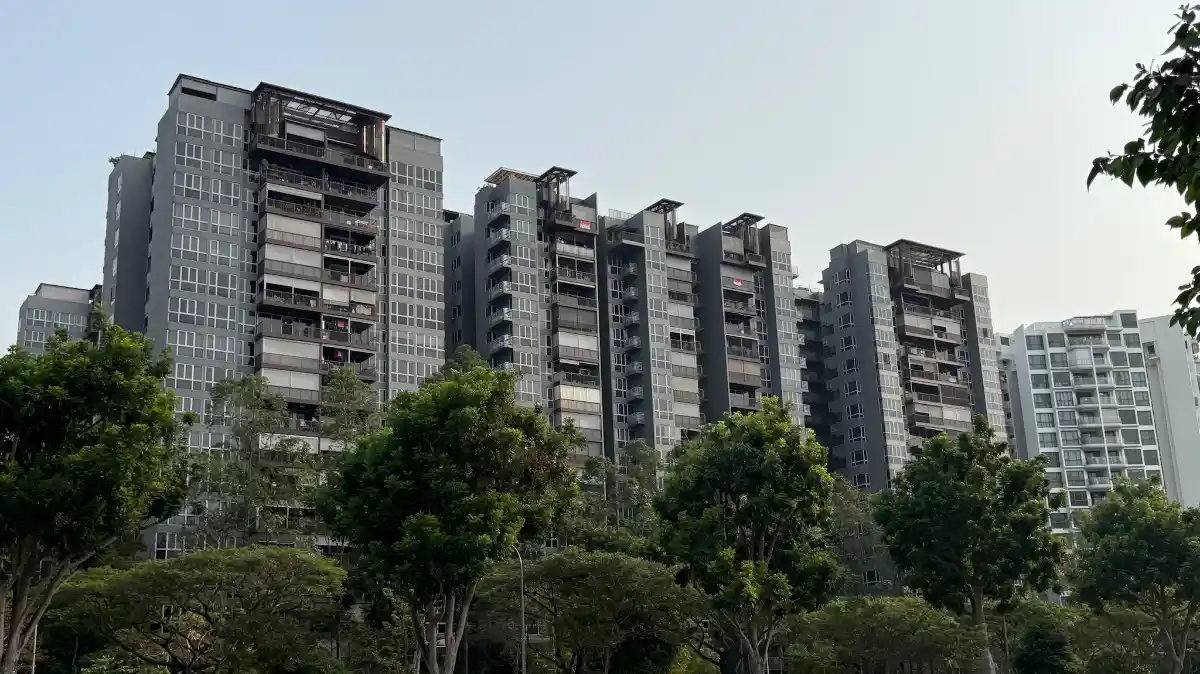
Holland Plain is a residential precinct that does not exist yet. Eight Government Land Sales plots are planned for it, and as of September 2026 exactly one project is launching there. That project is Amberwood at Holland, and the case being made for it rests on three claims: it bought the cheapest land in the precinct, it has no small units, and it sits within 1km of Methodist Girls’ School.
Each claim is checkable. Below we go through what the public record actually supports, what it does not, and which parts a buyer should verify independently before booking day on 26 September 2026.
Sim Lian won the Holland Link site with a bid of $368.37 million, or $1,432 per square foot per plot ratio, submitting the top of five bids when the tender closed in July 2025. URA awarded the site on 7 August 2025.
Nine months later, Sim Lian went back for the adjoining Holland Plain parcel — and was the only bidder. That sole bid came in at $454 million, or $1,491 psf ppr. The developer has signalled a second Holland Plain project for the second quarter of 2027. URA is scheduled to launch the third Holland Plain plot in December 2026.
So the precinct’s land floor is now fixed at $1,432 psf ppr, and it was fixed by Amberwood. Every subsequent launch in Holland Plain starts from $1,491 or higher — and the December plot will be tendered after Amberwood has already shown developers what buyers will pay here.
The clearest recent illustration of how a precinct reprices itself sits in District 9, where URA released three adjacent parcels over roughly two years.
| Parcel | Tender closed | Land rate | Project | Launch outcome |
|---|---|---|---|---|
| A | Jun 2024 | $1,325 psf ppr | River Green | Aug 2025 — 88% of 524 units sold at an average of $3,130 psf |
| B | Feb 2025 | $1,420 psf ppr | River Modern | Mar 2026 — over 90% of 455 units sold at an average of $3,266 psf |
| C | Jun 2026 | $1,730 psf ppr | Not yet named | Land bought after A and B had proven demand |
Sources: URA GLS tender results; launch figures as publicly reported by EdgeProp and The Edge Singapore. Parcel C drew four bids, with the top bid 21.8% above Parcel B and only 6.4% ahead of the lowest bid — a narrow spread suggesting agreement on value rather than a single aggressive outlier.
The pattern is the point. Parcel A was bought when the precinct was unproven and attracted only two bids. Parcel C was bought after two sell-out launches, and cost 30.6% more per square foot of plot ratio. The developer who paid $1,730 will not be selling homes at River Green’s prices.
Holland Plain is one tender into the same sequence. Whether it follows the same path is not knowable in advance — District 9 near Great World MRT and District 10 beside a landed enclave are different markets, and the River Valley parcels came to market during an unusually strong CCR run. But the direction of land cost in the Bukit Timah–Holland corridor has been consistent: the Dunearn Road site went to a Frasers-led joint venture at $1,410 psf ppr in mid-2025, Holland Link followed at $1,432, and the second Holland Plain plot at $1,491.
What this does not mean. A lower land cost gives a developer room to price competitively. It does not oblige them to, and it is not a floor under resale value. What it does establish is the entry cost every future Holland Plain competitor must now build on top of.
Amberwood is 212 units across 11 low-rise blocks: 74 three-bedroom, 74 four-bedroom and 64 five-bedroom homes, sized from roughly 872 to 1,572 sqft. There are no one- or two-bedroom units at all.
That is unusual for the area. Most recent Holland and Bukit Timah projects lean heavily on compact stock — at several nearby developments, one- and two-bedroom units make up more than half of all homes, and in one case over 80%.
The consequence shows up in two places.
In the resale market around Amberwood, larger units have generally transacted at a higher psf than two-bedders in the same project — commonly a high single-digit to low double-digit premium at established projects such as Fourth Avenue Residences, One Holland Village Residences and Royalgreen. At Dunearn House, a current new launch, the spread across bedroom types is close to flat, which is typical of developer pricing before a project has a resale history.
Bedroom-level psf comparisons of this kind are compiled from transaction data on portals such as 99.co, drawing on URA and Realis records. Figures vary with the date range, project set and unit filter applied, so treat the pattern as directional rather than precise, and check current caveats yourself before relying on any specific number.
When a development contains a large block of small units, its headline average psf is pulled upward by those units — small units almost always carry the highest psf in a project. A future buyer comparing Amberwood’s transacted average against a neighbouring project’s average is therefore not comparing like with like, unless the unit mix is similar.
For an owner, the practical version of this argument is narrower and more defensible than the marketing version: at Amberwood, every resale comparable inside the development will be another family-sized home. There is no compact-unit tier setting a separate, higher psf benchmark that a three-bedroom seller has to be measured against.
The trade-off is real and worth stating. No small units means no low-quantum entry point, a smaller buyer pool at resale, and a higher absolute cheque — entry is $2,568,000 for an 872 sqft three-bedroom. Family-sized-only developments live or die on owner-occupier demand.
Methodist Girls’ School sits at 11 Blackmore Drive — and so does MGS Secondary. Both sections share the same campus. The primary section is government-aided; the secondary section is independent, and affiliated students from MGS Primary enter with priority, reflected in noticeably lower PSLE AL bands than open-posting applicants.
This is why the school argument at Amberwood is structured differently from a normal one-kilometre claim.
For an owner-occupier, that length is the argument. An address tied to a decade of schooling on one campus is an address a family is slower to sell. Fewer forced sellers in a small 212-unit development is a meaningful structural feature — though it cuts both ways, since thin resale volume also means fewer recent comparables when you do want to sell.
King Albert Park is currently a Downtown Line station. Under Phase 2 of the Cross Island Line, targeted for completion in 2032, it becomes a DTL–CRL interchange — and at 50 metres deep across five basement levels, LTA expects it to be Singapore’s deepest station. Clementi becomes the line’s other Phase 2 interchange, with the East-West Line.
Completion is a target, not a guarantee, and 2032 is six years out. Buyers should treat it as planned infrastructure with a stated timeline rather than a delivered amenity.
Longer-run comparisons in this corridor are suggestive but not conclusive. The Tessarina on Wilby Road (freehold, completed 2003) and The Sixth Avenue Residences (freehold, completed 2009) sit at different distances from MGS, and the older, lower-priced project has over time closed and in places exceeded the gap in average psf.
Take that carefully. Project-level average psf moves with age, unit mix, renovation cycles, block position and transaction volume, not school distance alone. Two projects are not a dataset. If school catchment matters to your purchase, measure the actual distance from the specific development on OneMap and check the current MOE registration rules — not a marketing map, and not this article.
Taken together, the land ladder, the unit mix and the school catchment describe a coherent thesis. They do not answer the question that decides the purchase, which is whether the launch price is right.
Check these yourself before you commit
OneMap for the actual home-to-school distance. MOE for current P1 registration phases and priority rules. URA for GLS tender results and Master Plan zoning. LTA for CRL2 station and completion updates. URA Realis or a transaction portal for recent caveats in the comparison projects. Every figure in this article comes from those public sources or from publicly reported launch results, and all of them are checkable without going through an agent.
Our team can send you the current price list, floor plans, site plan, available units and stack-level guidance, and walk you through how the numbers above apply to a specific layout and budget. Public booking day is 26 September 2026.
WhatsApp us for the price listSee the full Amberwood project page
Full project details — unit mix, floor plans, site plan, facilities, fittings and the complete indicative price table — are on our Amberwood at Holland page. For the nearest comparable launch in the same corridor, see Dunearn House, and for other prime-district projects, our Core Central Region new launches listing.
All figures are indicative and subject to change. Land rates, tender outcomes and launch results are as publicly reported by URA, LTA and property media at the time of writing; transaction-based comparisons vary with the date range and filters applied. Pricing, unit availability, unit sizes, school distance, MRT timelines and TOP should be verified against the latest official developer sales documents and the relevant authorities before any purchase decision. This article is general market commentary and not financial or investment advice.